What to Consider When Renting a Private-Pool Villa
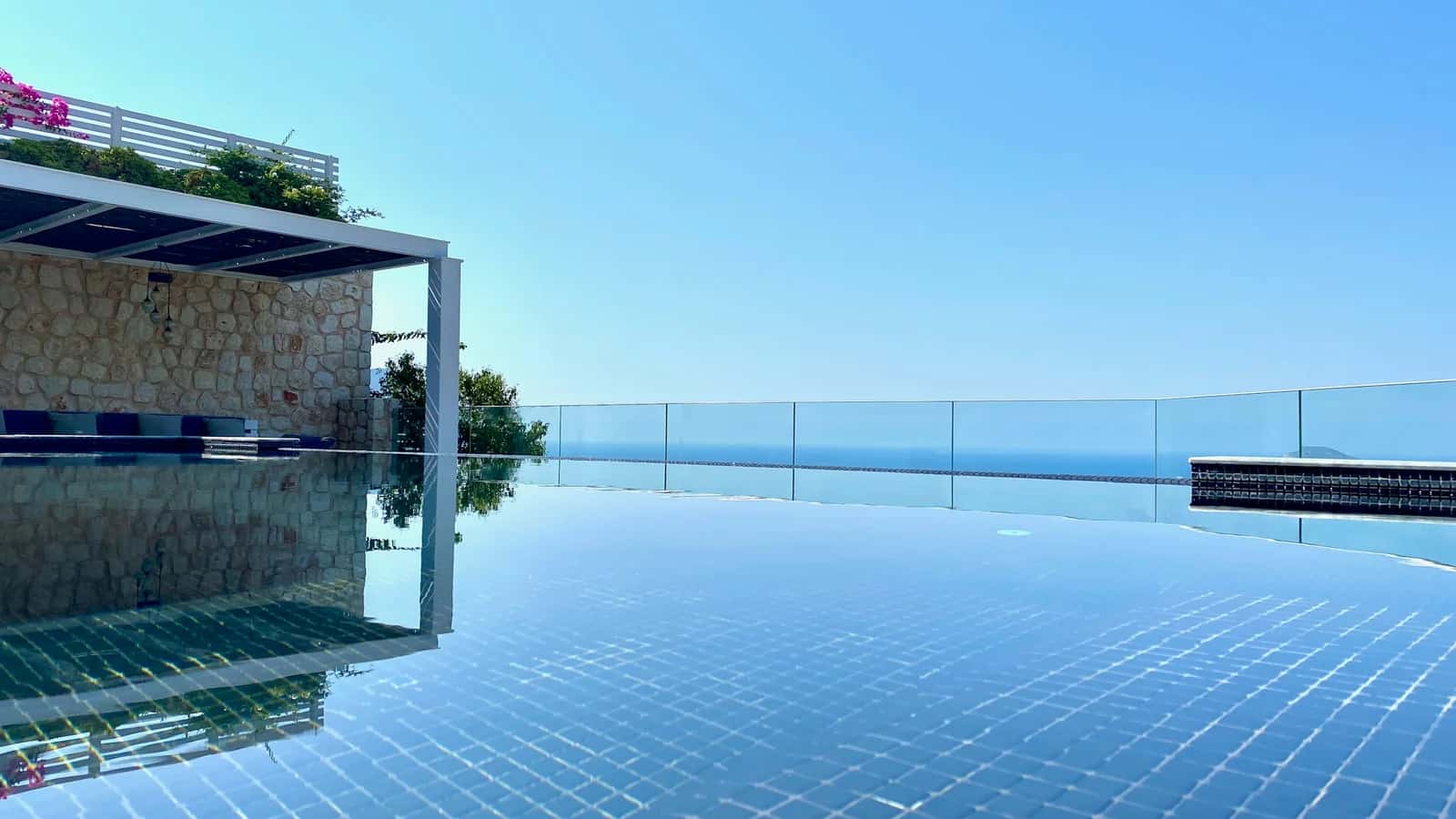
Renting a villa with a private pool does not end with looking at the photographs. The size of the pool, its privacy, the maintenance routine, child safety and the lighting scheme — the details that shape the daily rhythm of a stay begin precisely here.
Pool Size: Swimming Area or Cooling Off?
In a private-pool villa, the size of the pool is the first variable that shapes the daily rhythm of the stay. A measure should be set in square metres taking the number of guests into account: pool surface roughly three times the number of guests is a general reference point. For a villa sleeping 8, a pool of 24-30 square metres offers a comfortable swimming area; this size means a flexibility in which two people can swim at the same time while the remaining guests can cool off in different parts of the pool. Smaller pools — for example 12-15 square metres — are designed for cooling off rather than swimming and may be sufficient for honeymoon couples or small groups; for large families, however, they restrict the daily flow of the pool.
The shape of the pool also matters. Rectangular or long, narrow-plan pools are ideal for swimming exercise; geometric forms create an architectural impression. Pools with irregular or curved forms carry a more relaxed, residential-pool feel. In a family villa where children will play, a pool with a long, shallow side creates both a swimming area for adults and a safe playing ground for children.
Depth: The Difference Between Standard and Design
Standard pool depth is around 1.40 metres; this is a level at which an average adult can stand. Deeper designs — 1.80-2.20 metres — are suitable for guests who do swimming training but require a separate solution on their own for small children. Shallow-side designs are a form in which one end of the pool begins at 30-50 cm depth and deepens with a gentle slope towards the other end; this design is common in family-oriented villas.
Whether or not there is a children's pool is a decisive criterion for families with small children. A separate children's pool (30-50 cm deep) directly affects the family's daily rhythm; the children have a safe play area, and the adults stay in the main pool at their own pace. In villas without a separate pool, a shallow design on one side of the main pool offers an alternative.
Privacy: The Criterion That Makes a Villa a Villa
Privacy is almost always among the top three criteria in choosing a private-pool villa. A pool being "private" is about not being visible while in use, not merely about belonging to the villa. What the line of sight from the neighbouring property is, how close the road descending from the slope comes to the pool, whether a boat passing on the seaward side can see the pool — the answers to these three questions determine a villa's level of privacy.
In hillside villas, privacy depends on the pool being positioned at an upper level; the pool of a villa at an upper level is not visible from the villas below. In villas facing the shore, privacy depends on the length of the garden between the shore and the pool and on the density of construction.
The choice of plants in the garden is also part of privacy. Cypress, laurel and old olive trees create a natural screen and bring the area surrounding the pool closer to the feeling of an interior space.
Maintenance Routine: From Water Quality to Equipment
In a boutique villa stay, pool maintenance is always included in the price. Professional cleaning two to three times a week is standard; in some boutique villas this frequency rises to daily cleaning. Maintenance covers measuring the chlorine level, balancing the pH, cleaning the filter and brushing the visible surfaces.
Water quality is a hidden but decisive parameter of the stay. A chlorine concentration that is too high dries out guests' skin; one that is too low creates a health risk. Pools with a saltwater system offer a gentler use in this respect; the salt forms a softened version of the chlorine in the water and does not sting the eyes.
The quality of the pool's plant room is a detail that is not directly visible but is felt over a long stay. If the filtration system is not working properly, a slight cloudiness in the water's colour begins in the middle of the season. Preventing this depends on the plant room's arrangement being reviewed annually.
Safety: Child Barriers and Lighting
In villas where families with children stay, two additional features gain importance for pool safety. The first is whether there is a child barrier around the pool; some villas set up a temporary barrier on request. The second is whether there is an alarm system at the bottom of the pool; in a portion of modern boutique villas this system is standard.
Lighting is another parameter that determines how the pool is used in the mature hours of the season. In-pool LED lighting gives the water surface a visual quality suited to night-time use. For the surrounding area, ground lighting — recessed spotlights — renders the garden in a dramatic way. In most modern boutique villas the lighting can be adjusted via a dimmer.
Loungers, Umbrellas and the Surrounding Area
The quality of the equipment around the pool is as important as the pool itself. In a high-quality boutique villa the number of loungers should equal the number of guests; one lounger per guest ensures that the poolside does not become crowded during the busy hours of the season.
The placement of the umbrellas also matters. In the hottest hours of the season — between 13:00 and 16:00 — there should be a shaded area at the poolside that can comfortably keep at least four people in the shade. Fixed shade structures — a pergola or a wooden arbour — are a more reliable solution than portable umbrellas.
A small kitchenette or service area by the pool provides an ideal comfort for preparing coffee, drinks and light snacks throughout the day. In high-quality boutique villas there is a small refrigerator by the pool.
Water Temperature Through the Season: Does a Heated Pool Matter?
The structure of Bodrum's season generally shows that the pool water is comfortable from mid-May to mid-October. However, at the start and end of the season — May and October — the water temperature can be between 18 and 22 degrees; this is a slightly cool temperature for swimming. For this reason, some boutique villas have a pool heating system; this system raises the water temperature to 26-28 degrees and allows the season to be extended.
A heated pool is a decisive criterion for guests staying out of season. For guests considering a stay in early May, mid-October or even early November, the presence of a heating system is a comfort that directly changes the experience of the stay.
Concierge Support: More Than the Pool
A private-pool villa stay is defined as much by the quality of the team behind it as by the physical features of the pool. Our concierge team plans services such as an afternoon offering by the pool, an evening dinner at the poolside with a private chef, or a children's swimming instructor with a single message. While the physical quality of the pool forms the foundation that establishes the first day of a stay, the rhythm of the following days is shaped by the quality of the concierge team.
Sıkça Sorulanlar
Roughly three square metres of pool surface per guest is a general measure. For a villa sleeping 8, a pool of 24-30 square metres offers a comfortable swimming area. Smaller pools are suitable for cooling off but may not be enough for swimming.
Bodrumapartvilla Editör Ekibi
2013'ten bu yana Bodrum'da butik villa konaklaması üzerine çalışan editör ekibi. Yalıkavak, Türkbükü, Gümüşlük ve Turgutreis başta olmak üzere bölgedeki konaklama dinamiklerini doğrudan mülk sahibi ağı ve sahadaki konsiyerj deneyimiyle ilk elden biliyor.
Profil & tüm yazılarıRelated guides and pages